
1. Operating temperature: -30℃~120℃
2. Sealing pressure: Vacuum butterfly valve can withstand 0.5Mpa without leakage; hard seal butterfly valve can withstand 0.1Mpa without leakage.
3. Minimum tolerance level: ISO12944-6 C4-M
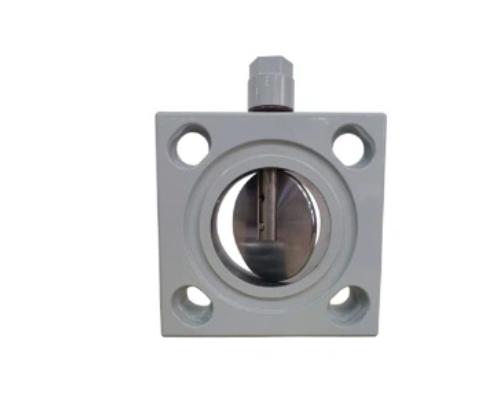
1. With the valve cover removed, the butterfly valve’s open/closed status should be clearly visible. If the locating pin is close to the “OPEN” mark, the butterfly valve is open; if it’s close to the “CLOSE” mark, the butterfly valve is closed.
Note: The red arrow on the shaft head indicates the valve plate direction; facing the pipe diameter indicates open, and perpendicular to the pipe diameter indicates closed.
2. When installing the butterfly valve, it should be in the closed position. Please check if the flange hole spacing matches the butterfly valve. If the flange hole spacing is incorrect, stop installation immediately.
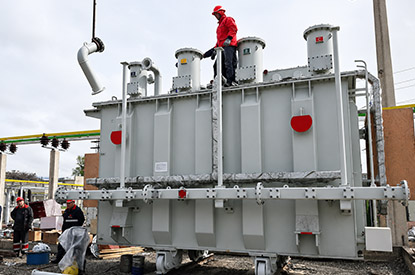
3. When hoisting transformer components, prevent the butterfly valve from being subjected to impact. All sealing rings are made of special rubber; if any are damaged and need replacement, please contact our company.
4. During installation, ensure the butterfly valve is concentric with the flange inner hole and tighten all mounting bolts evenly to avoid damage to the butterfly valve seals due to uneven force during tightening.
5. Opening and Closing Operation Method
5.1. Use an adjustable wrench to unscrew the valve cover counterclockwise. Remove the valve cover and its seal together and keep them safe.
5.2. According to the direction indicated by the limit indicator on the valve shaft, rotating it 90 degrees counterclockwise will open the butterfly valve, and rotating it 90 degrees clockwise will close it.
6. When installing the valve cover, pay attention to the valve’s open/closed state. The red arrow indicates the valve plate direction; facing the pipe diameter indicates open, and perpendicular to the pipe diameter indicates closed. Locate the markings corresponding to the current valve’s open/closed state, cover the seal to expose the corresponding markings, and finally tighten the valve cover clockwise.
| Common Fault | Cause Analysis | Solution |
|---|---|---|
| Valve Door Closing Failure | Check whether the flange matches the valve door, or whether the flange does not match the valve port. The valve plate may touch the flange during rotation, preventing normal opening and closing. | Replace with the correct valve door. |
| Valve Oil Leakage | Oil leakage at the connection between the valve and flange. Check whether the mounting bolts are tightened and whether the sealing gasket is damaged. | Tighten the mounting bolts evenly or replace the sealing gasket. |
| Valve Plate Oil Leakage | According to the standard, a certain amount of leakage is allowed for hard-sealed butterfly valves. If the leakage exceeds the standard value, it may be caused by long-term wear of the valve plate. | Please contact our company. |
| Screw Rod Oil Leakage | Oil leakage from the screw rod may be caused by damaged sealing components. | Please contact our company to replace the sealing components. |
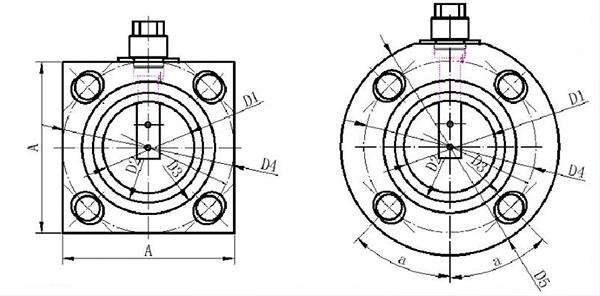
| No. | Nominal Diameter DN | Series No. | Nominal Pressure (KPA) | Pitch Circle Diameter D4 | Bolt Specification | Angle α | D1 | D2 | D3 | D5 / A*A | Shape | Thickness |
|---|---|---|---|---|---|---|---|---|---|---|---|---|
| 1 | 50 | 1 | 150 | 125 | 4-M12 | 45 | 50 | 68 | 88 | 125×125 | Square | 35 |
| 2 | 80 | 1 | 150 | 150 | 4-M20 | 45 | 80 | 95 | 115 | 150×150 | Square | 35 |
| 3 | 80 | 2 | 150 | 160 | 4-M16 | 45 | 80 | 95 | 115 | 150×150 | Square | 35 |
| 4 | 80 | 3 | 150 | 150 | 4-M20 | 45 | 80 | 95 | 115 | 190 | Round | 35 |
| 5 | 100 | 1 | 250 | 180 | 8-M16 | 22.5 | 100 | 125 | 145 | 220 | Round | 35 |
| 6 | 125 | 1 | 250 | 200 | 8-M16 | 22.5 | 125 | 149 | 169 | 250 | Round | 40 |
| 7 | 125 | 2 | 250 | 210 | 8-M16 | 22.5 | 125 | 149 | 169 | 250 | Round | 40 |
| 8 | 150 | 1 | 250 | 240 | 8-M20 | 22.5 | 150 | 177 | 201 | 280 | Round | 40 |
| 9 | 200 | 1 | 250 | 295 | 8-M20 | 22.5 | 200 | 218 | 250 | 340 | Round | 40 |
| 10 | 250 | 1 | 250 | 350 | 12-M20 | 15 | 250 | 285 | 312 | 390 | Round | 40 |