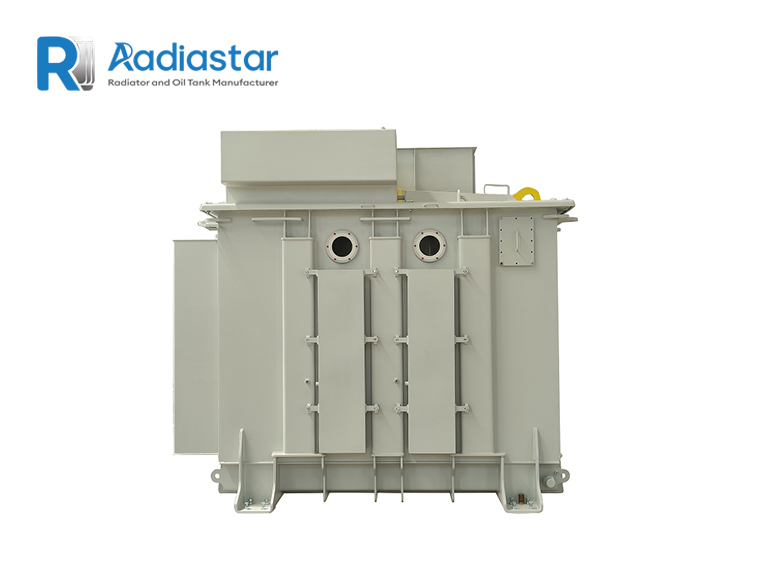

A transformer tank must contain insulating oil safely for decades, often under positive internal pressure, vacuum during oil filling, and fluctuating thermal loads. Even a pinhole leak can lead to oil loss, moisture ingress, insulation failure, and catastrophic transformer damage. That is why pressure testing and leak testing are non-negotiable quality gates in transformer tank manufacturing.
This article explains the most common pressure and leak test procedures used for transformer tanks: air pressure test, hydrostatic test, vacuum test, and dye penetrant inspection. It covers test pressures, holding times, acceptance criteria, and what buyers should expect from a qualified OEM transformer tank manufacturer.
Radiastar performs these tests on every custom transformer tank before shipment. Our goal is to help transformer factories, EPC contractors, and utility engineers understand the test methods so they can specify and verify leak-proof performance with confidence.
Transformer tanks are welded steel structures that hold insulating oil. During service they face:
Internal pressure from oil expansion due to temperature rise
Vacuum during vacuum drying and oil filling processes
External atmospheric pressure changes
Mechanical vibration from core and winding
Thermal cycling that stresses welds and gaskets
A tank that passes visual inspection may still leak under pressure or vacuum. Leakage leads to:
Reduced dielectric strength of insulating oil
Moisture and gas ingress
Environmental contamination
Fire risk
Unplanned outages and warranty claims
Therefore, pressure and leak tests are essential quality checks before a transformer tank is delivered. They verify weld integrity, gasket sealing, flange flatness, and overall structural soundness.
Long-tail keyword: transformer tank leak test procedure and acceptance criteria
The air pressure test is the most common method for detecting leaks in transformer tanks. It is relatively quick, clean, and does not introduce moisture into the tank.
Procedure:
Seal all openings with blind flanges, test plugs, or temporary covers.
Connect a regulated dry air supply and a calibrated pressure gauge.
Pressurize the tank to the specified test pressure, typically 0.5 to 1.0 bar (50–100 kPa) above atmospheric.
Hold the pressure for a specified duration, commonly 15 to 30 minutes, depending on the standard or customer requirement.
Apply a soap solution or leak-detection spray to all welds, flanges, nozzle connections, and gasketed joints.
Observe for bubbles. Any continuous bubble formation indicates a leak.
After test, depressurize slowly and remove temporary seals.
Long-tail keyword: air pressure test for transformer oil tank
Advantages:
Fast and economical
No risk of water contamination
Can be combined with soap bubble or ultrasonic leak detection
Limitations:
Air is compressible, so small leaks may be missed if pressure is not held long enough
Large tanks may require longer stabilization time due to temperature effects on air pressure
The hydrostatic test uses water to verify both leak tightness and structural strength. It is often specified for large power transformer tanks or when higher test pressures are required.
Procedure:
Close all openings with appropriate test flanges.
Fill the tank completely with clean water, ensuring no trapped air.
Apply pressure using a test pump to the specified hydrostatic test pressure.
Common test pressure: 1.3 to 1.5 times the maximum working pressure, or as specified by the customer.
Hold pressure for 15 to 60 minutes, depending on the standard.
Inspect all welds, joints, and surfaces for leakage, deformation, or abnormal displacement.
Drain and dry the tank thoroughly after the test.
Long-tail keyword: hydrostatic test pressure for transformer tank
Advantages:
Water is incompressible, so it reveals even small leaks
Also tests structural strength under load
Accepted by most international standards
Limitations:
Water must be completely removed and the tank dried to prevent corrosion
Heavier and more time-consuming than air test
Requires proper disposal of test water if additives are used
Transformer tanks must often withstand vacuum during oil filling and drying processes. A vacuum test verifies that the tank will not collapse or allow air ingress under negative pressure.
Procedure:
Seal all openings.
Connect a vacuum pump and a calibrated vacuum gauge.
Reduce internal pressure to the specified vacuum level, commonly -0.3 to -0.5 bar relative to atmospheric.
Hold vacuum for a specified duration, often 15 to 30 minutes.
Monitor pressure rise. A rapid rise indicates leakage or structural deflection.
Inspect for visible deformation, especially on large flat panels.
Long-tail keyword: transformer tank vacuum test procedure
Advantages:
Simulates actual service condition during oil filling
Detects leaks that only appear under negative pressure
Verifies stiffener adequacy
Limitations:
Requires strong temporary sealing
Large flat panels may deflect even when airtight, so structural evaluation is important
Dye penetrant testing is a non-destructive testing method used to detect surface-breaking defects in welds, such as cracks, porosity, and lack of fusion.
Procedure:
Clean the weld surface thoroughly.
Apply penetrant and allow dwell time (typically 10–30 minutes).
Remove excess penetrant.
Apply developer.
Inspect under adequate lighting for indications.
Long-tail keyword: dye penetrant testing for transformer tank welds
Advantages:
Detects very fine surface cracks
Low cost and portable
Works on all non-porous materials
Limitations:
Only detects surface-breaking defects
Requires clean surface and controlled procedure
Does not verify through-thickness weld integrity
The following table summarizes typical test parameters for transformer tanks. Actual values depend on the applicable standard, customer specification, and tank design.
| Test Type | Common Test Pressure/Vacuum | Typical Holding Time | Standard Reference |
|---|---|---|---|
| Air pressure test | 0.5–1.0 bar (50–100 kPa) | 15–30 min | IEC 60076-1, IEEE C57.12.00 |
| Hydrostatic test | 1.3–1.5 × working pressure | 15–60 min | EN 50216, customer spec |
| Vacuum test | -0.3 to -0.5 bar | 15–30 min | Manufacturer standard |
| Dye penetrant test | N/A | Dwell 10–30 min | ISO 3452, ASTM E165 |
Long-tail keyword: transformer tank pressure test pressure and holding time
Radiastar follows customer-specified values and can recommend test parameters based on tank design and service conditions. We always document the actual test pressure, holding time, and results in the final quality dossier.
A tank passes the leak test when:
No visible leakage is detected at any weld, flange, or joint
No continuous bubble formation during air pressure test
Pressure drop does not exceed the allowable limit after temperature compensation
No visible permanent deformation during hydrostatic or vacuum test
No surface-breaking defects found during dye penetrant inspection
Long-tail keyword: transformer tank leak test acceptance criteria
If a leak is found, the area is marked, repaired, and retested according to the same procedure. Radiastar does not ship tanks with unrepaired leaks or unverified repairs.
No single test detects all possible defects. Radiastar uses a combination of tests to ensure leak-proof performance:
Welding stage: visual inspection plus dye penetrant testing on critical welds
After fabrication: air pressure test with soap solution
When specified: hydrostatic test and vacuum test
Final inspection: pressure test report, dimensional check, coating inspection
This multi-stage approach reduces the risk of field failures and gives customers documented evidence of quality.
Long-tail keyword: transformer tank manufacturer pressure testing capability
Most transformer tank air pressure tests use 0.5 to 1.0 bar above atmospheric pressure. The exact value depends on the tank design and customer specification. Holding time is typically 15 to 30 minutes.
Yes, if the transformer will be vacuum dried or filled with oil under vacuum. The vacuum test verifies that the tank can withstand negative pressure without collapsing or leaking.
Air pressure test is faster and uses dry air, while hydrostatic test uses water and verifies both leak tightness and structural strength. Hydrostatic testing is more sensitive to small leaks because water is incompressible.
No. Dye penetrant testing detects surface weld defects, while pressure testing verifies overall leak tightness. They are complementary methods.
Transformer tank pressure and leak testing are critical quality gates that separate professional manufacturers from low-cost workshops. Buyers should specify test methods, pressures, holding times, and documentation requirements clearly in their RFQ.
Radiastar performs air pressure, hydrostatic, vacuum, and dye penetrant testing according to international standards and customer requirements. Every tank is tested and documented before shipment. Contact our engineering team to discuss your testing requirements or request a sample test report.